GSA Elyvion
The Orbital Fleet Support Complex
Building the infrastructure that builds humanity's future in space.

Overview
GSA Elyvion is a permanently deployable orbital manufacturing, fleet support, and spacecraft sustainment complex developed by Greg Stanley Aerospace Concepts (GSA).
Unlike traditional spacecraft designed solely for exploration, Elyvion is purpose-built to become permanent orbital infrastructure. It functions as an industrial shipyard, orbital manufacturing center, maintenance facility, logistics hub, and fleet support complex capable of constructing, expanding, repairing, and modernizing spacecraft throughout their operational lifetimes.
Designed for modular deployment, Elyvion launches in transportable sections before being assembled in Earth's preferred orbital construction and maintenance environment. Once operational, it transforms into a massive orbital manufacturing platform capable of supporting generations of future exploration vehicles. Rather than repeatedly launching fully assembled spacecraft from Earth's gravity well, Elyvion enables humanity to manufacture, maintain, and evolve spacecraft where they are needed most, in space itself.
Mission
The future of human spaceflight depends not only on larger launch vehicles, but on permanent orbital infrastructure capable of supporting continuous exploration. GSA Elyvion exists to provide that infrastructure. Its mission is to establish a reusable orbital industrial complex capable of constructing, servicing, upgrading, and sustaining fleets of spacecraft for decades while dramatically reducing the need to return major vehicles to Earth for reconstruction or replacement. As humanity expands beyond Low Earth Orbit, Elyvion provides the manufacturing capability necessary to support long-term operations around Earth, the Moon, Mars, and future deep-space destinations.
Phase 2 Initial Orbital Assembly

Following orbital assembly, Elyvion exists as a compact orbital support vessel containing:
-
Command and mission operations
-
Crew accommodations
-
Life support systems
-
Communications
-
Guidance and navigation
-
Power generation
-
Propellant management
-
Structural control systems
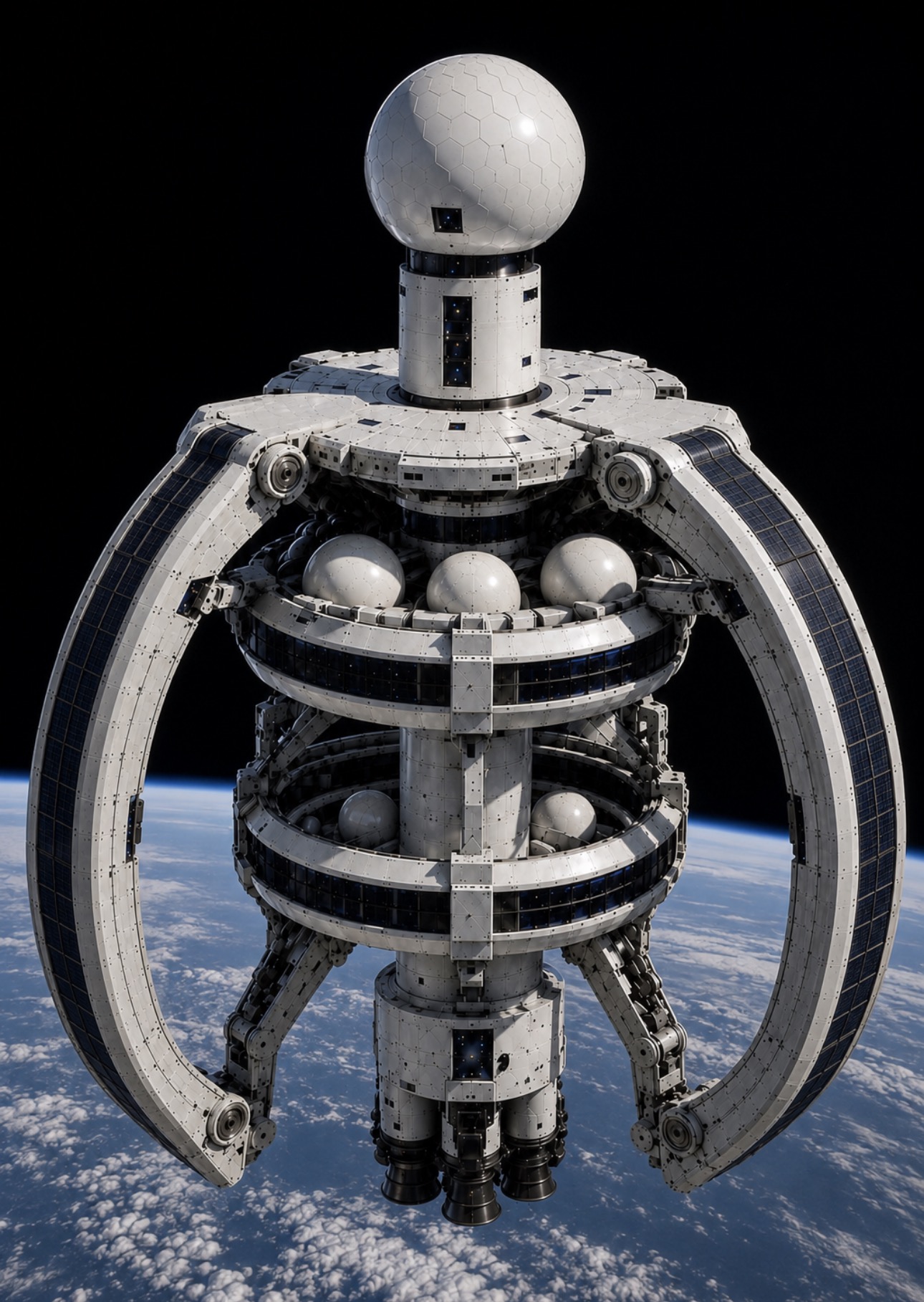
Its three exterior structural arms remain locked against the central structure during launch and transport, maximizing structural rigidity while minimizing launch volume.
Phase 3 Structural Deployment Expansion Complete

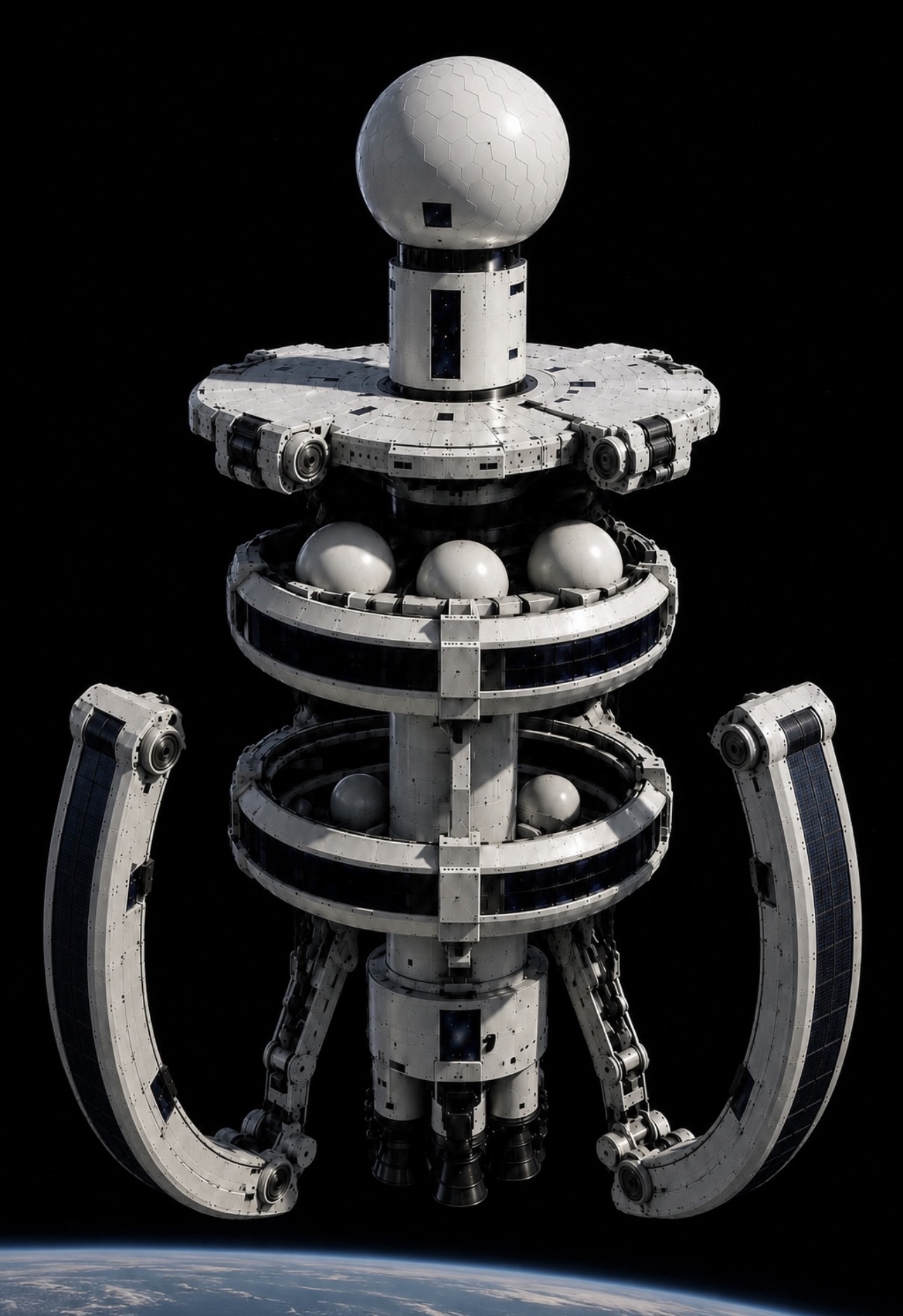
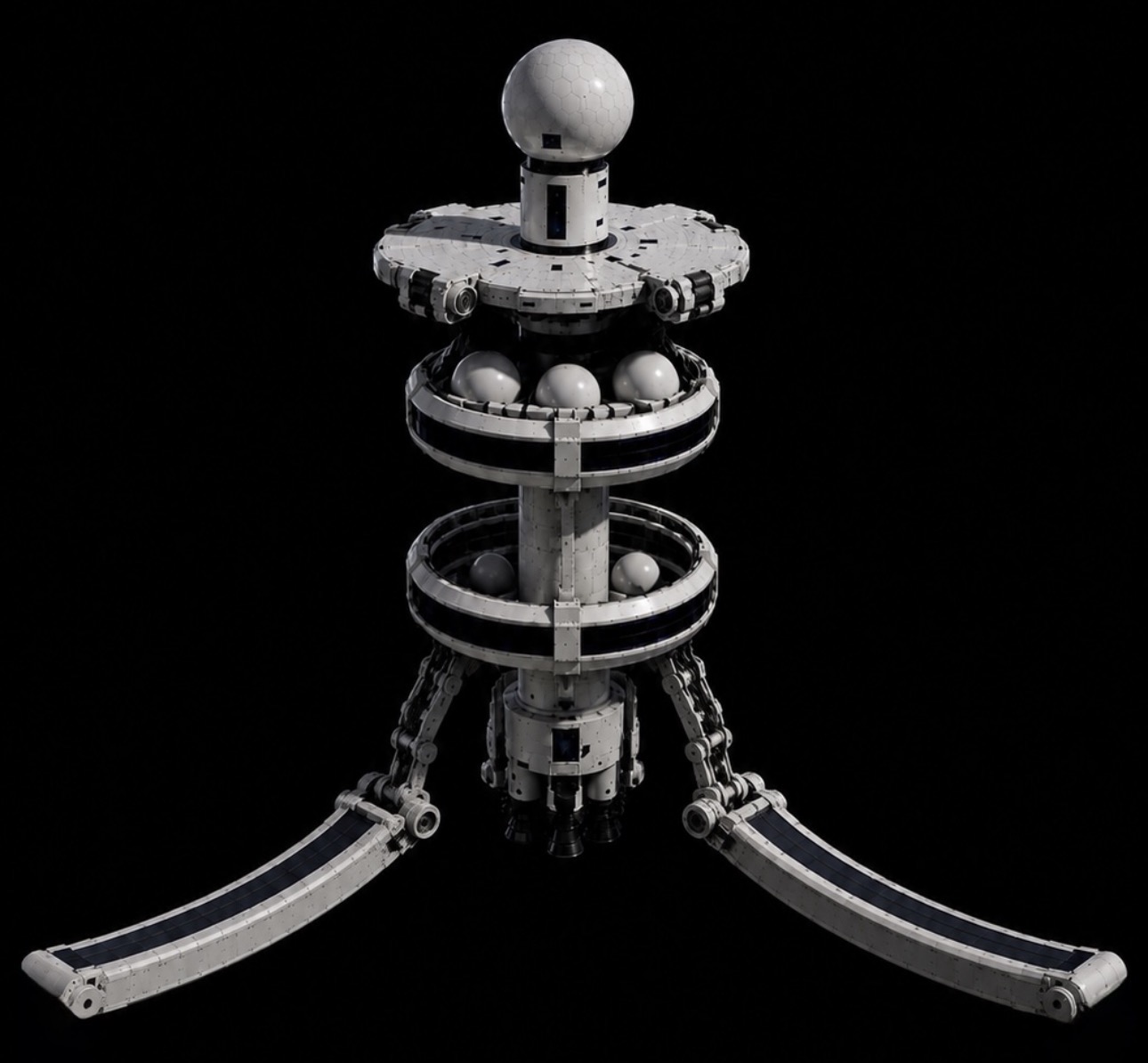
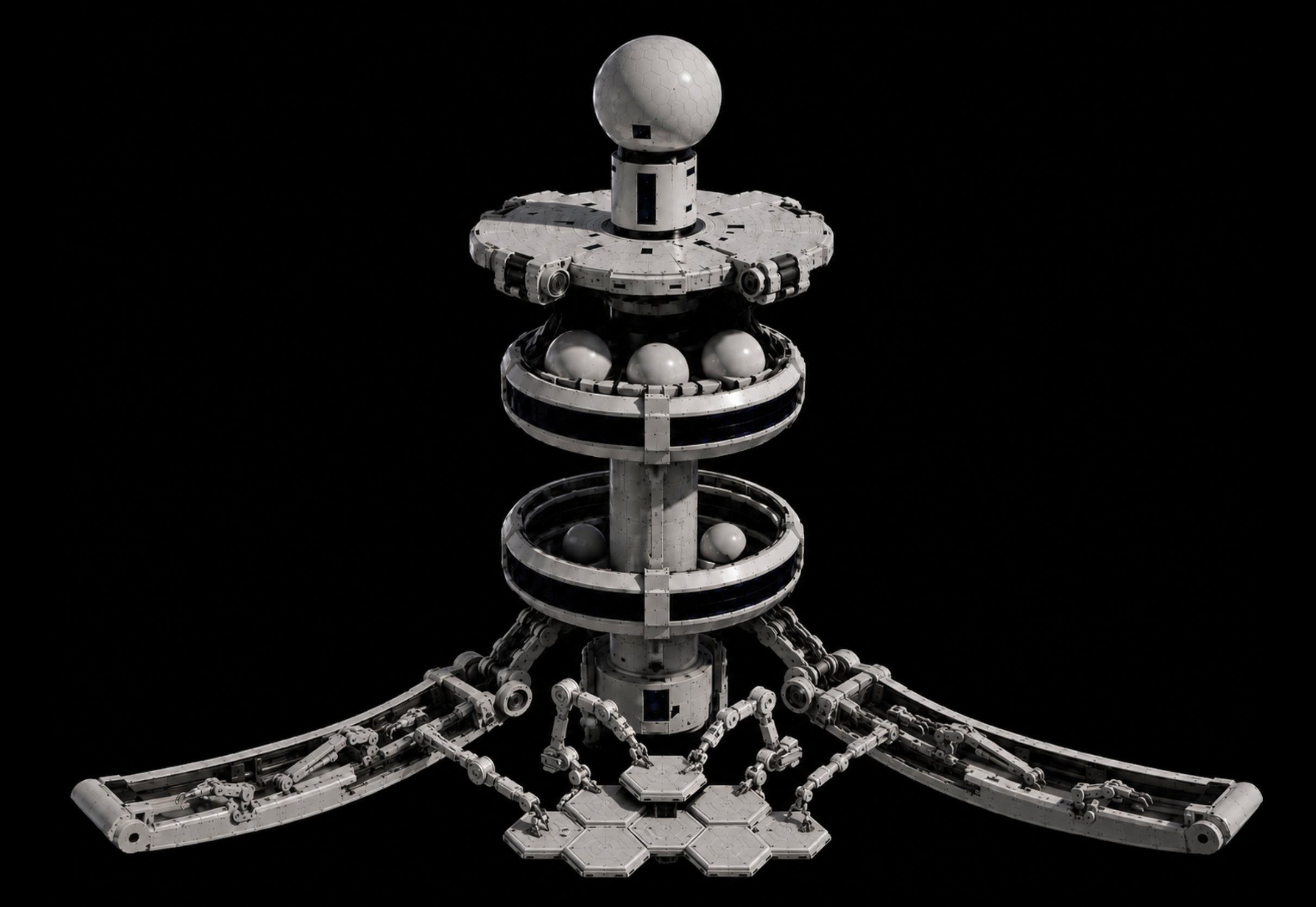
Following release from the upper structural deck, the three exterior arms continue their synchronized downward rotation until reaching their fully deployed horizontal positions. Once locked, the arms become the primary structural framework supporting Elyvion's expanding orbital manufacturing platform.
Phase 5 Manufacturing Platform Begins

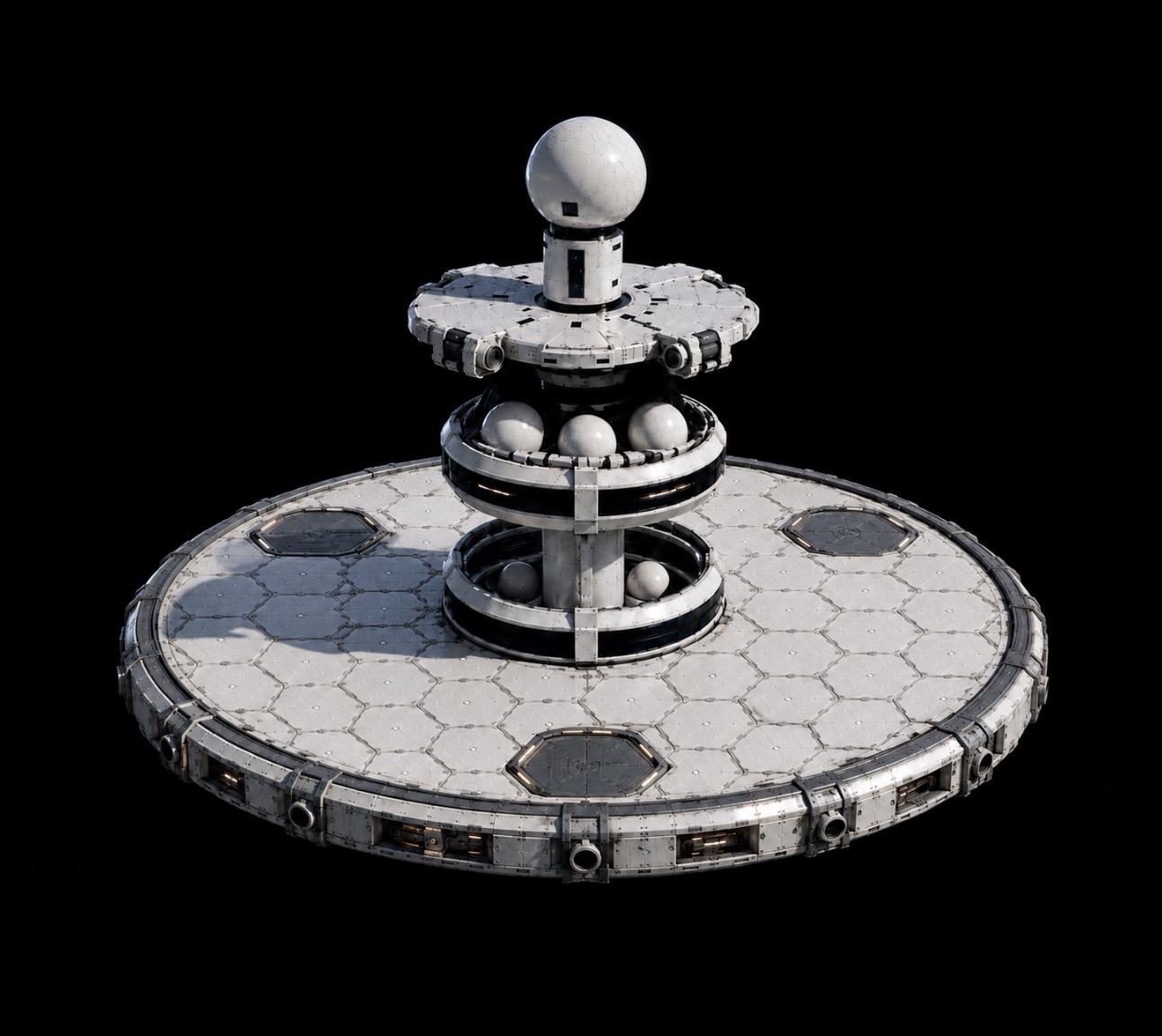
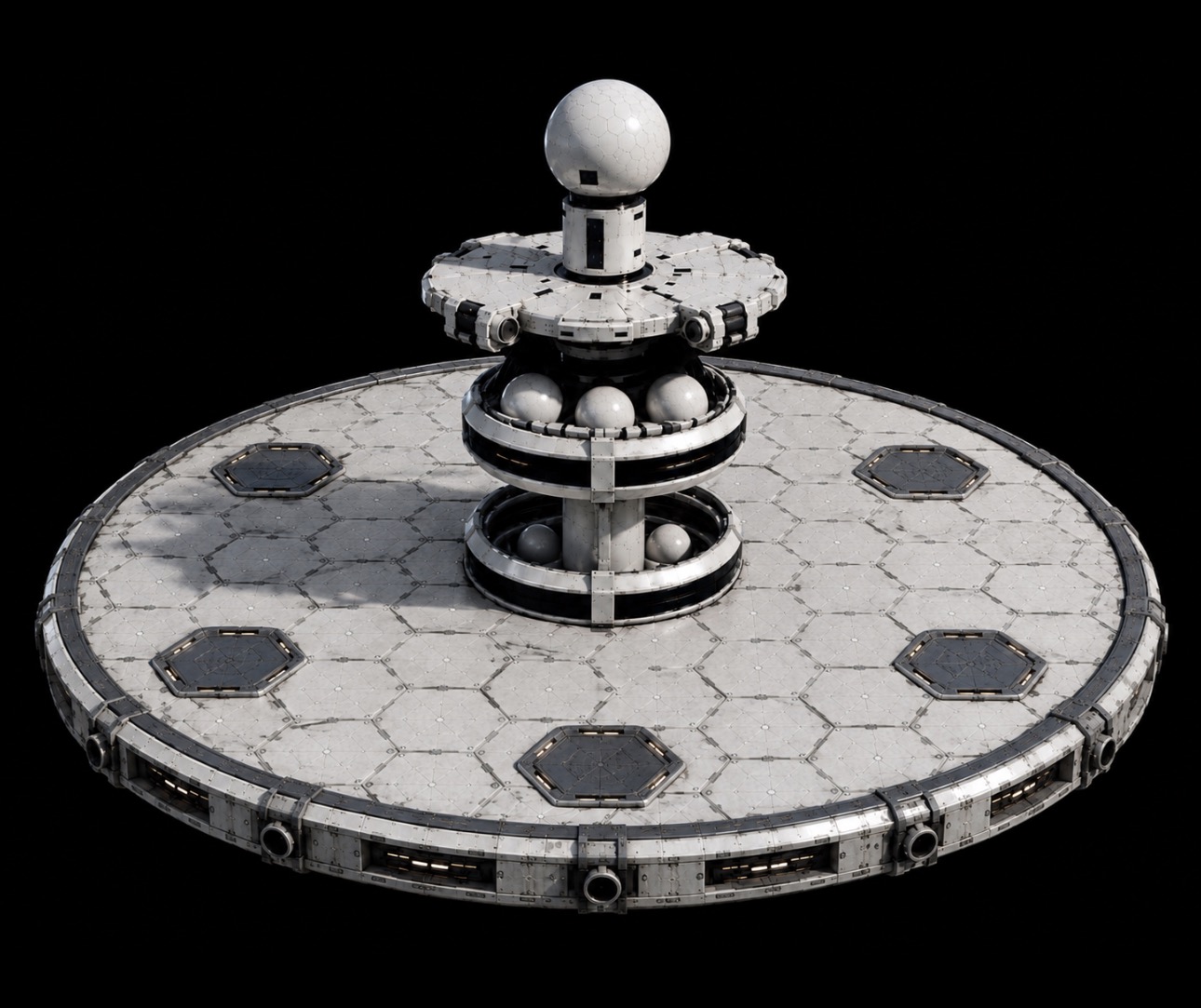
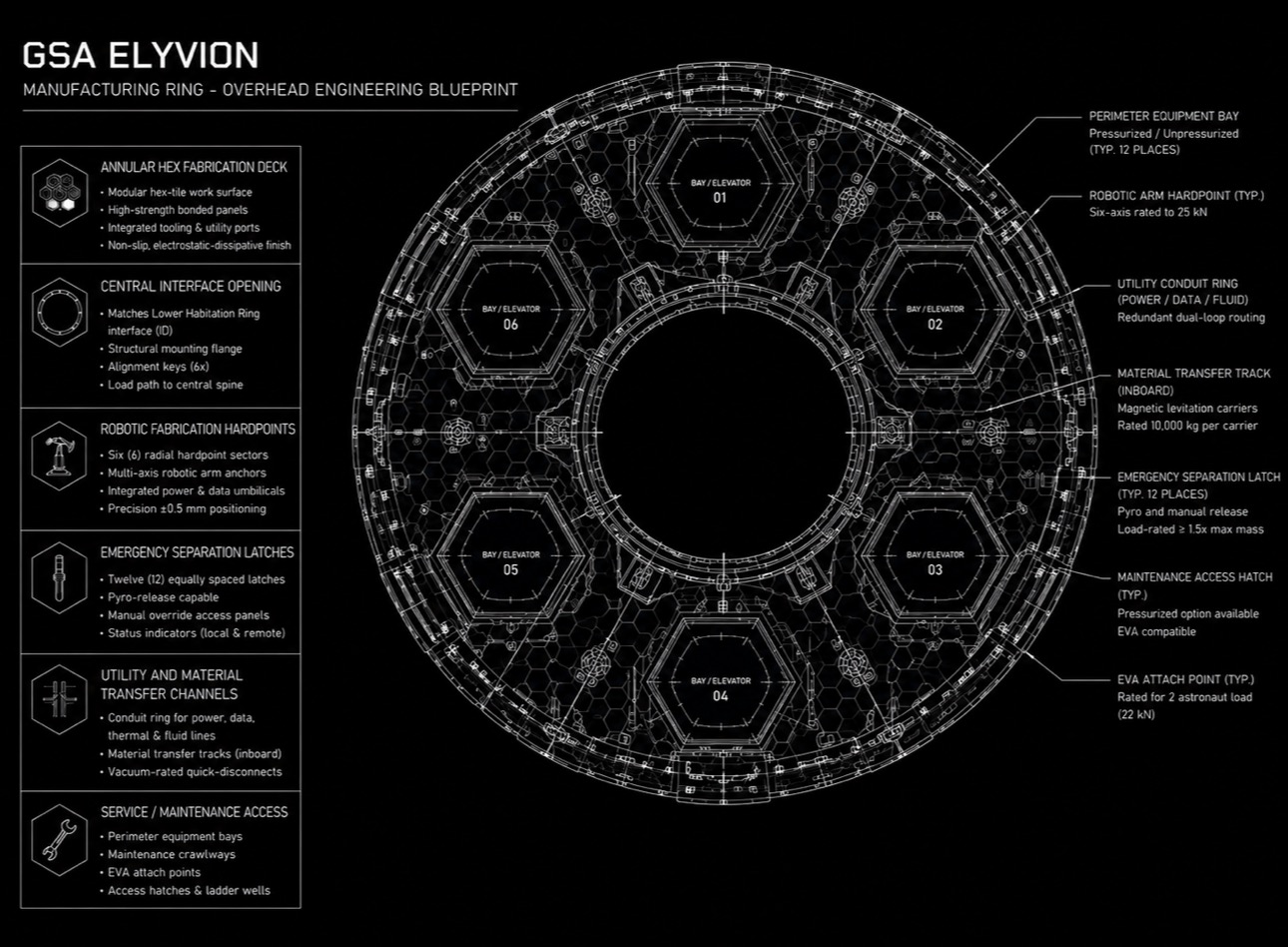
Using standardized structural hexagonal modules, Elyvion gradually constructs an enormous circular manufacturing platform beneath the central spacecraft. The platform expands outward through continuous modular growth until it becomes a large orbital manufacturing complex capable of supporting multiple spacecraft simultaneously. Unlike conventional stations built as fixed structures, Elyvion's manufacturing platform is intentionally designed for unlimited future expansion.
Individual sections can be:
-
Added
-
Removed
-
Replaced
-
Upgraded
-
Reconfigured
without affecting the remainder of the complex.
Deep Space Manufacturing Configuration (DMC)

Purpose
Designed for large-scale orbital construction, the Deep Space Manufacturing Configuration (DMC) features a significantly expanded manufacturing platform capable of constructing complete spacecraft, large orbital infrastructure, permanent space facilities, and next-generation exploration systems in support of sustained human expansion beyond Earth.
Primary Operations
-
Complete spacecraft assembly
-
Orbital station construction
-
Habitat and habitation modules
-
Fleet production and expansion
-
Heavy structural fabrication
-
Logistics and cargo platforms
-
Docking and utility modules
-
Deep-space infrastructure development

Fleet Manufacturing & Life Cycle Support
Elyvion serves as the permanent manufacturing, maintenance, and fleet sustainment complex for the Greg Stanley Aerospace Concepts (GSA) ecosystem and its supporting partners. Its robotic manufacturing systems are designed to construct new spacecraft, fabricate replacement components, perform long-term maintenance, and support continuous modular expansion throughout each vehicle's operational lifetime.
Primary supported programs include the GSA Caelune, Caelune Transport Variant, Caelune Cargo Variant, USS SX1 Haven One, and Empyrean.
Beyond supporting GSA programs, Greg Stanley Aerospace Concepts is committed to collaboration with commercial, private, academic, international, and government organizations that share the goal of advancing humanity's presence in space. GSA welcomes opportunities to work alongside organizations from the United States and its allied and partner nations to accelerate innovation, strengthen orbital infrastructure, and promote the peaceful expansion of space exploration and development.
Through permanent orbital manufacturing, modernization, and life-cycle support, Elyvion is designed to help individuals, companies, research institutions, and governments establish, expand, and sustain long-term space-faring capabilities while reducing the cost and complexity of operating beyond Earth.
This collaborative philosophy establishes a resilient orbital industrial ecosystem capable of supporting human exploration throughout Earth orbit, cislunar space, the Mars system, and future destinations beyond.


.jpeg)
.jpeg)


Click each image to expand visuals and info
Core Objectives
-
Permanent orbital manufacturing
-
Long-term spacecraft maintenance
-
Modular spacecraft expansion
-
Fleet logistics and support
-
Orbital infrastructure development
-
Sustainable industrial growth beyond Earth
Deployment Architecture
-
Phase One
-
Orbital Delivery
-
Elyvion is launched aboard multiple heavy-lift launch vehicles as modular structural components.
-
Each module is independently transported into Earth's preferred orbital construction environment before robotic assembly begins.
-
This approach removes the requirement for an exceptionally large single launch vehicle while allowing Elyvion to continue expanding throughout its operational lifetime.
Operational Philosophy
Traditional spacecraft transport people. Elyvion supports civilization. Rather than functioning as another spacecraft, Elyvion serves as the orbital equivalent of a modern industrial shipyard. It provides the facilities required to build, inspect, repair, upgrade, refuel, and expand entire spacecraft without requiring those vehicles to return to Earth for reconstruction. Every future spacecraft becomes part of a continuously evolving ecosystem instead of a standalone machine.
Phase 3 Structural Deployment
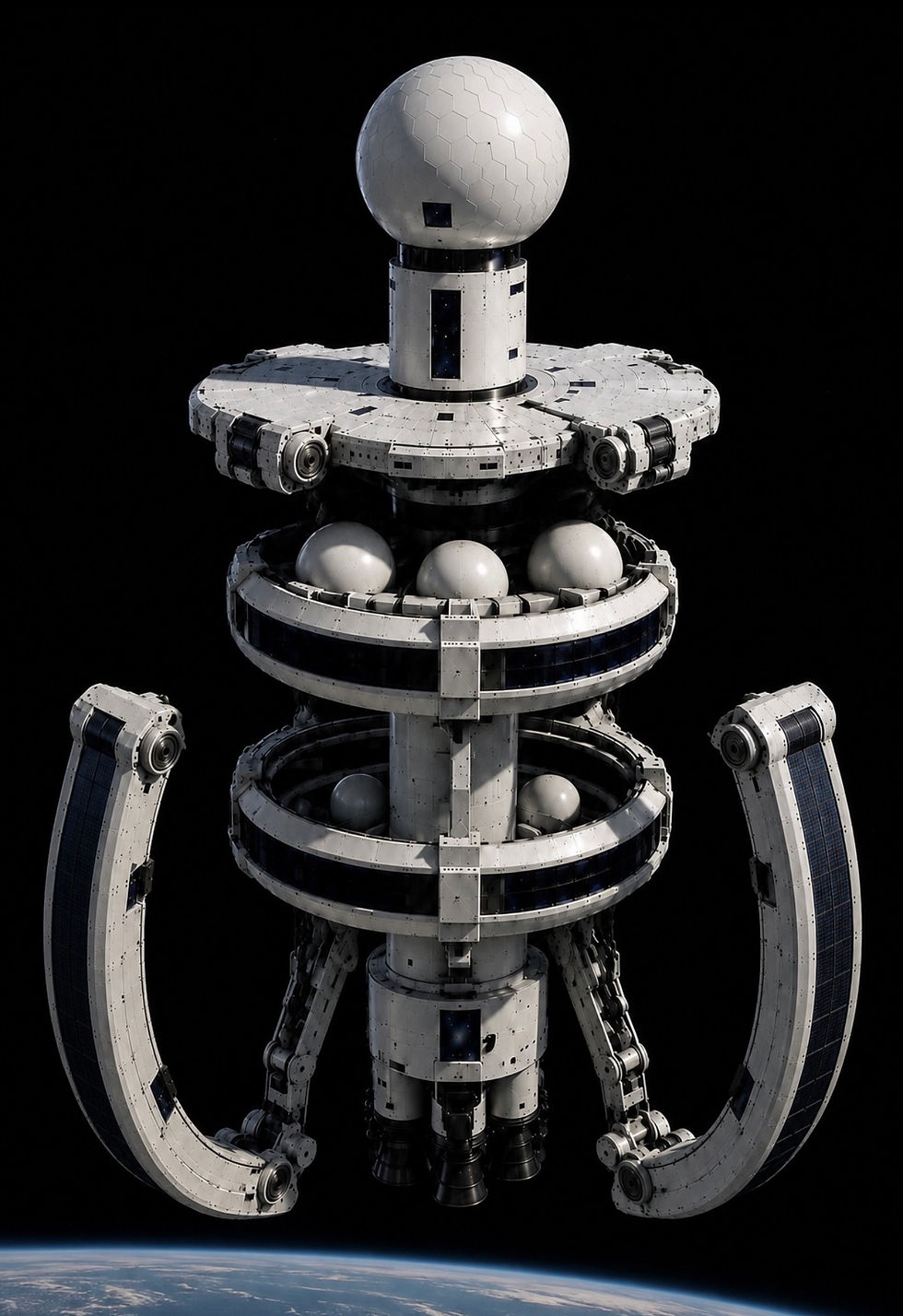
After arriving at its permanent operational orbit, the three exterior structural arms unlock from the upper structural deck and begin a synchronized deployment sequence. Each arm rotates downward through a controlled arc before reaching its fully deployed horizontal position. Once deployed, the arms become the primary structural joists supporting Elyvion's orbital manufacturing platform.
This deployment:
-
Increases the station's structural footprint.
-
Creates an expansive manufacturing envelope.
-
Separates industrial operations from inhabited modules.
-
Reduces vibration transfer into crewed systems.
-
Establishes the primary framework for future manufacturing expansion.
Phase 4 Manufacturing Systems Activated

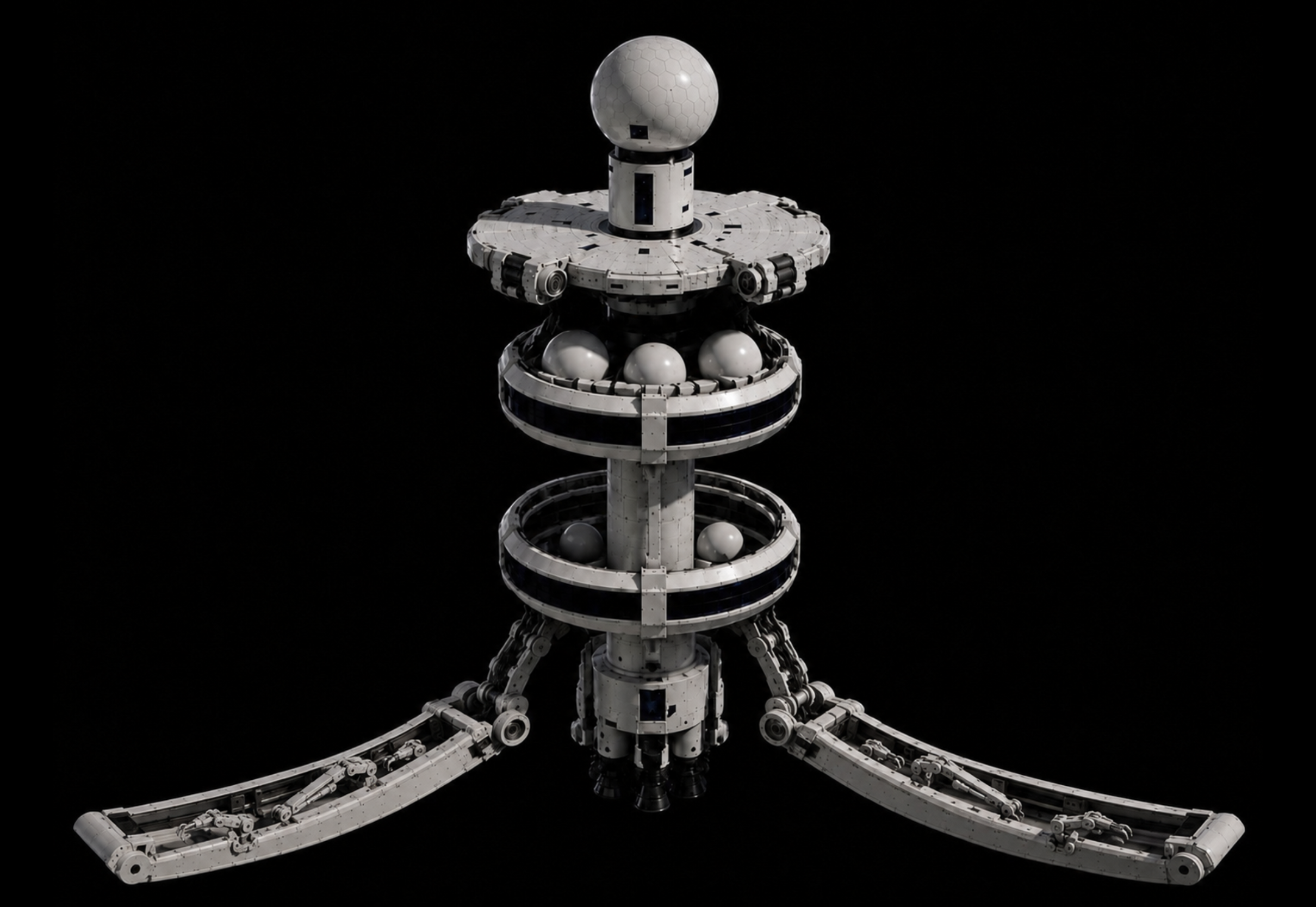
Integrated protective panels located along the inner surfaces of each structural arm slide downward into the arm framework. These retractable panels expose enclosed robotic manufacturing systems that remained protected throughout launch and deployment.
Each robotic fabrication system performs:
-
Structural assembly & Precision positioning
-
Automated welding & Modular installation
-
Inspection & Maintenance
-
Component replacement
-
Platform expansion
Each arm functions as an independent robotic construction facility, allowing multiple manufacturing operations to occur simultaneously while remaining under centralized mission control.
Local Manufacturing Configuration (LMC)

Purpose
Optimized for rapid fleet support and orbital maintenance, the Local Manufacturing Configuration uses a compact manufacturing platform to produce replacement parts, spacecraft upgrades, and mission-critical hardware.
Primary Operations
-
Replacement components
-
Spacecraft repairs
-
Module upgrades
-
Docking systems
-
Fleet maintenance
Catastrophic Failure Protection

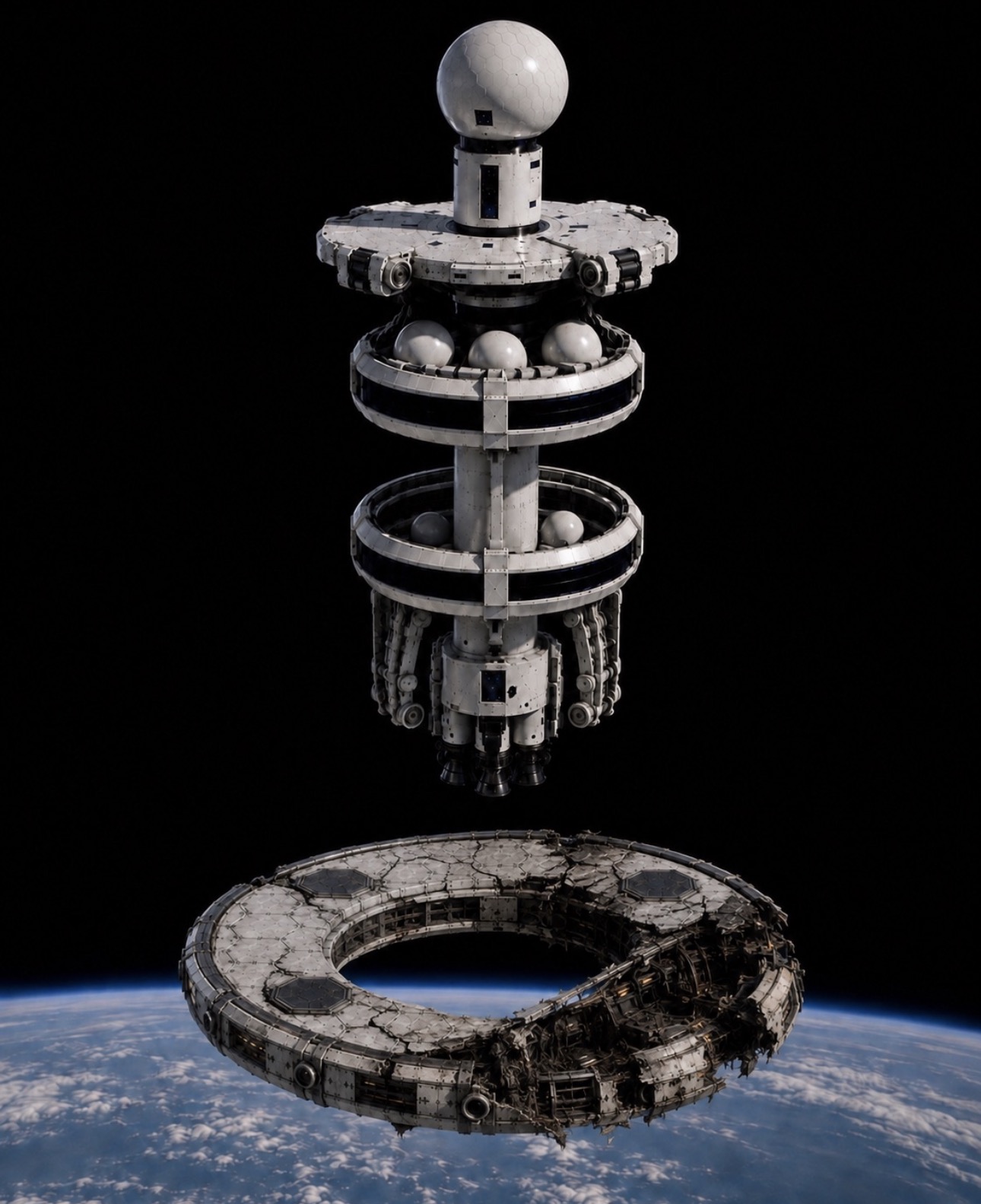
Safety remains a primary engineering objective throughout Elyvion's architecture. The orbital manufacturing platform is intentionally suspended beneath the inhabited command structure using the three primary structural hinge assemblies integrated into each exterior arm. Should the manufacturing platform experience a catastrophic event, including:
-
Internal explosion
-
Structural failure
-
Major fire
-
Orbital debris impact
-
Manufacturing accident
-
Propellant incident
the structural hinge assemblies can release the affected section, or if necessary, separate the entire manufacturing platform from Elyvion. This sacrificial architecture isolates industrial failures from the inhabited core, preserving the command vessel, crew, life-support systems, and mission-critical infrastructure. Because the manufacturing platform is completely modular, replacement sections can later be fabricated and installed using Elyvion's own robotic construction systems, restoring full operational capability without replacing the spacecraft itself.